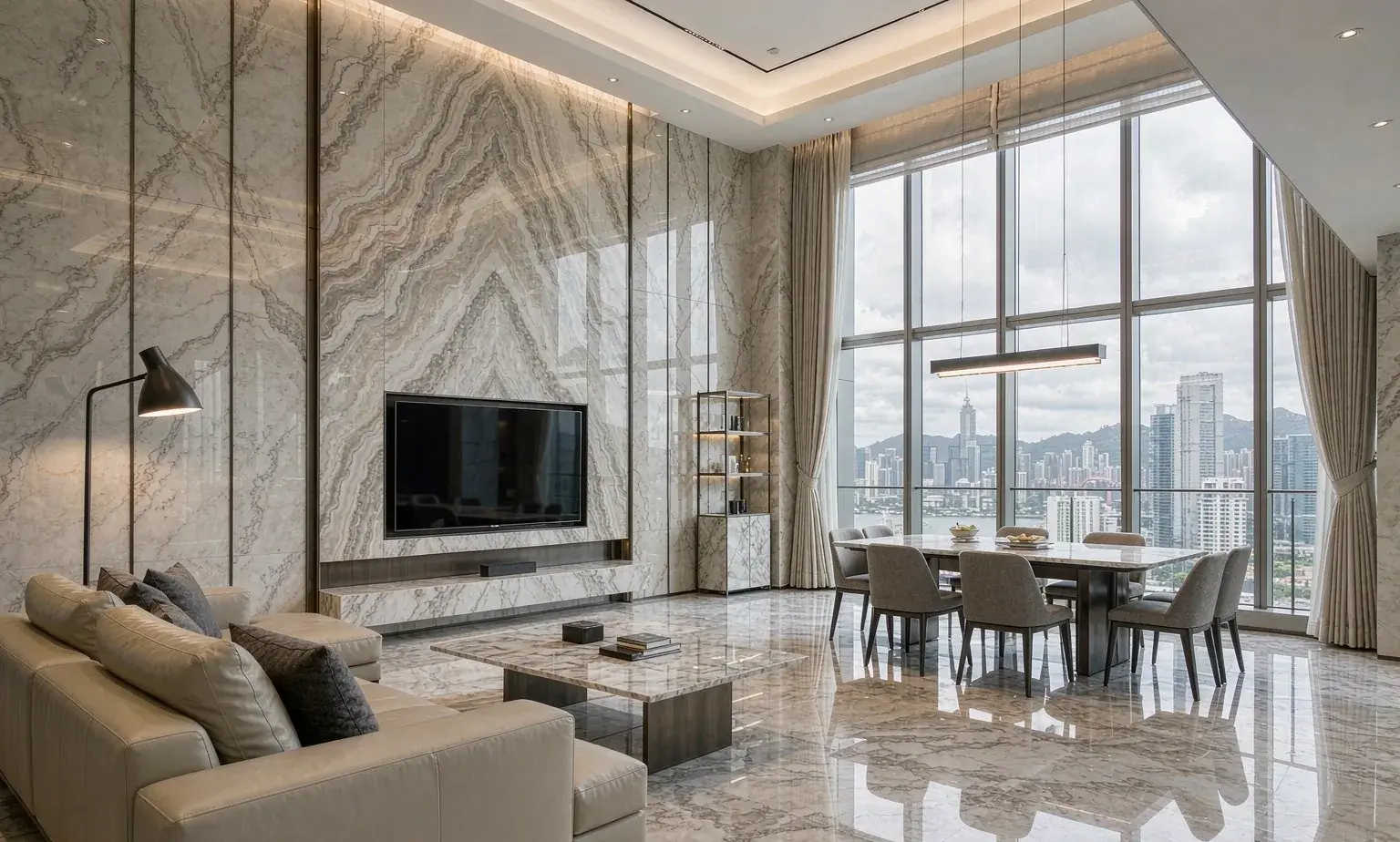
Why lighting elevates marble
Half of marble's beauty lies in the depth of its veining. Under flat ambient light that contrast washes out; cove lighting throws light across the surface at an angle, and shadows follow the grain, turning a wall from building material into a artwork. Evening lighting alone also works as soft indirect light that changes the whole mood of a living room. The one thing to plan early is the electrical rough-in — adding it later means surface wiring.
Which marble suits lighting best
Choose light backgrounds with clear veining: fish-belly white, snowflake white and landscape veins all respond beautifully, as light amplifies the tonal contrast. Darker varieties work too but need stronger sources and a honed finish to avoid mirror-like reflections. Always view slabs under lighting at our Mong Kok showroom before choosing — different slabs of the same variety react differently to light, and we can shortlist slabs with better translucency if you tell us the wall will be lit.
What is backlit stone
Backlit stone is marble sliced into thin panels, roughly 1 to 3 cm, with LED panels or a light box behind, so light passes through the stone and it glows like a lit screen. Light-coloured marble and onyx-type stones transmit best. Common applications: bar counters, reception backdrops, dining tables and entrance feature walls — mostly commercial, increasingly residential bars and master bathrooms. Cost runs higher than plain marble walls because of the thin-panel fabrication and lighting system, but the effect is one cove lighting cannot achieve.
Lighting details: temperature, evenness and access
Use 3000K warm white — it flatters stone; 4000K and above turns cold and artificial. LED strips must be evenly spaced with adequate output, or the wall shows zebra bands of light and dark; backlit panels need calculated evenness so edges match the centre. The most overlooked detail is maintenance access: LEDs have a finite life, so design an openable access panel — sealing it means demolishing the wall to replace strips years later. LEDs run cool, but the cove still needs ventilation space.
Cost structure and construction sequence
Plain cove lighting mainly adds electrical work and fittings; the stone is priced like any feature wall, usually under ten percent on top of the wall budget. Backlit stone costs more: thin-panel cutting, steel framework, LED panels and controls are itemised per square foot — a free measurement and itemised quotation is the realistic route. Sequence matters: fix the stone and lighting scheme first, rough-in the electrics, install the stone, then fit and aim the lights. Reversing this order is the most common and costly mistake.