Price: porcelain is clearly cheaper
Porcelain starts from tens of dollars per square foot, while natural marble with fabrication and laying generally starts from over a hundred, depending on variety. Remember to include wastage (10 to 20 percent for book-matched marble) and future maintenance, not just material price.
Appearance: natural veining versus high-fidelity print
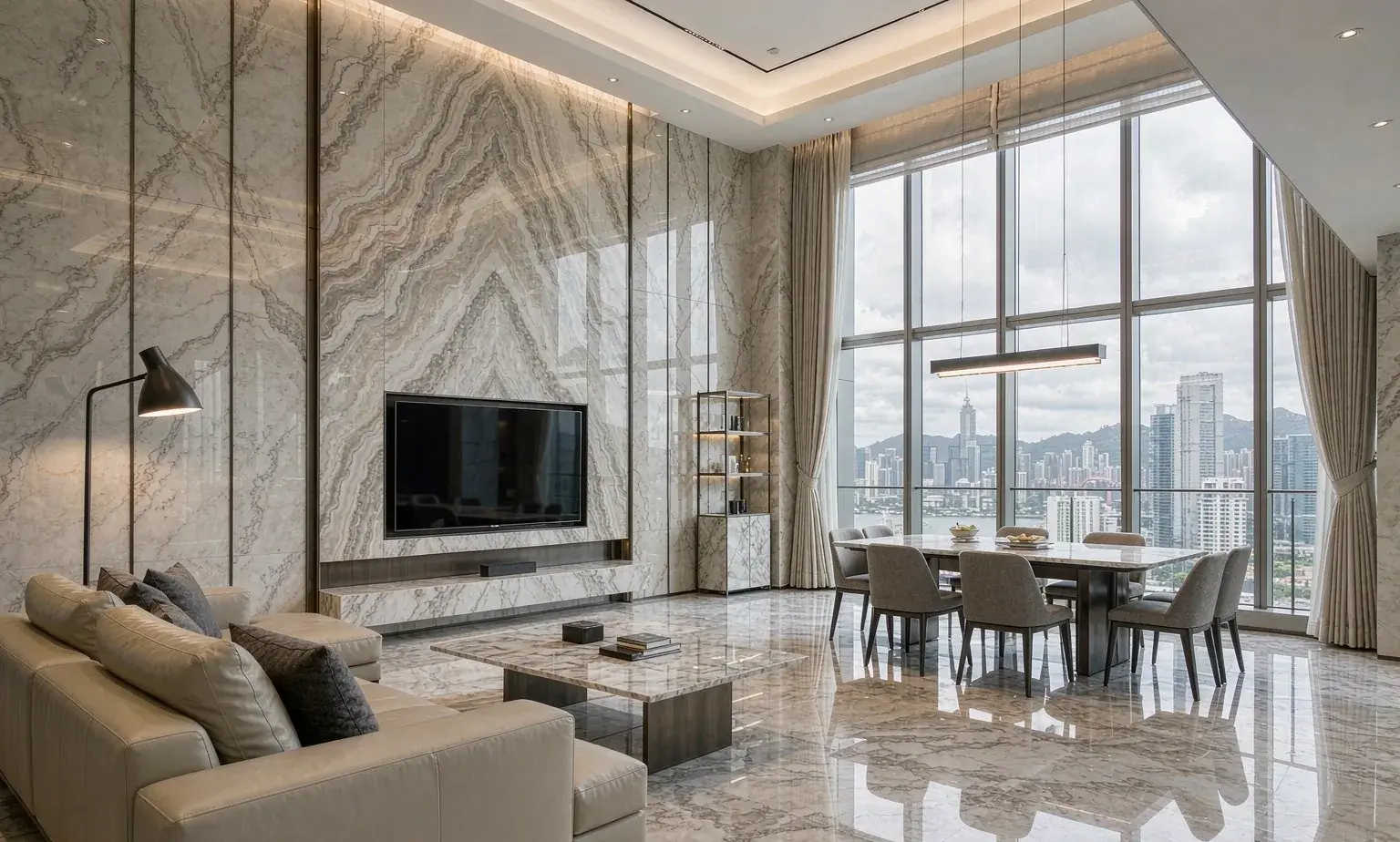
Every marble slab is unique, with depth and a solid feel, and can be book-matched. Large-format porcelain prints are impressively realistic today, but patterns repeat and veining breaks at joints. Close up and over large areas, natural marble still has a depth that porcelain cannot fully copy.
Durability and maintenance
Porcelain is non-porous, needs no sealing and resists staining, making it the lowest-maintenance option. Marble needs sealing, is vulnerable to acids and requires periodic care. But marble can be restored: dull or scratched surfaces can be re-polished, whereas a scratched porcelain glaze can only be replaced.
Joints and installation
Large-format porcelain comes in sizes up to 1600x3200 mm, giving far fewer joints than small tiles. Marble slabs are typically 3200x1600 mm and book-matched layouts give even fewer, more natural joints. Both demand flat substrates and similar labour costs.
Resale value and recommendation
Natural marble is generally seen as a plus in high-end homes; in mass-market housing it comes down to budget. In practice: choose marble when budget allows and you want character and uniqueness; choose large-format porcelain for low maintenance and value; or mix them, with marble floors in the living room and porcelain in kitchens and bathrooms.