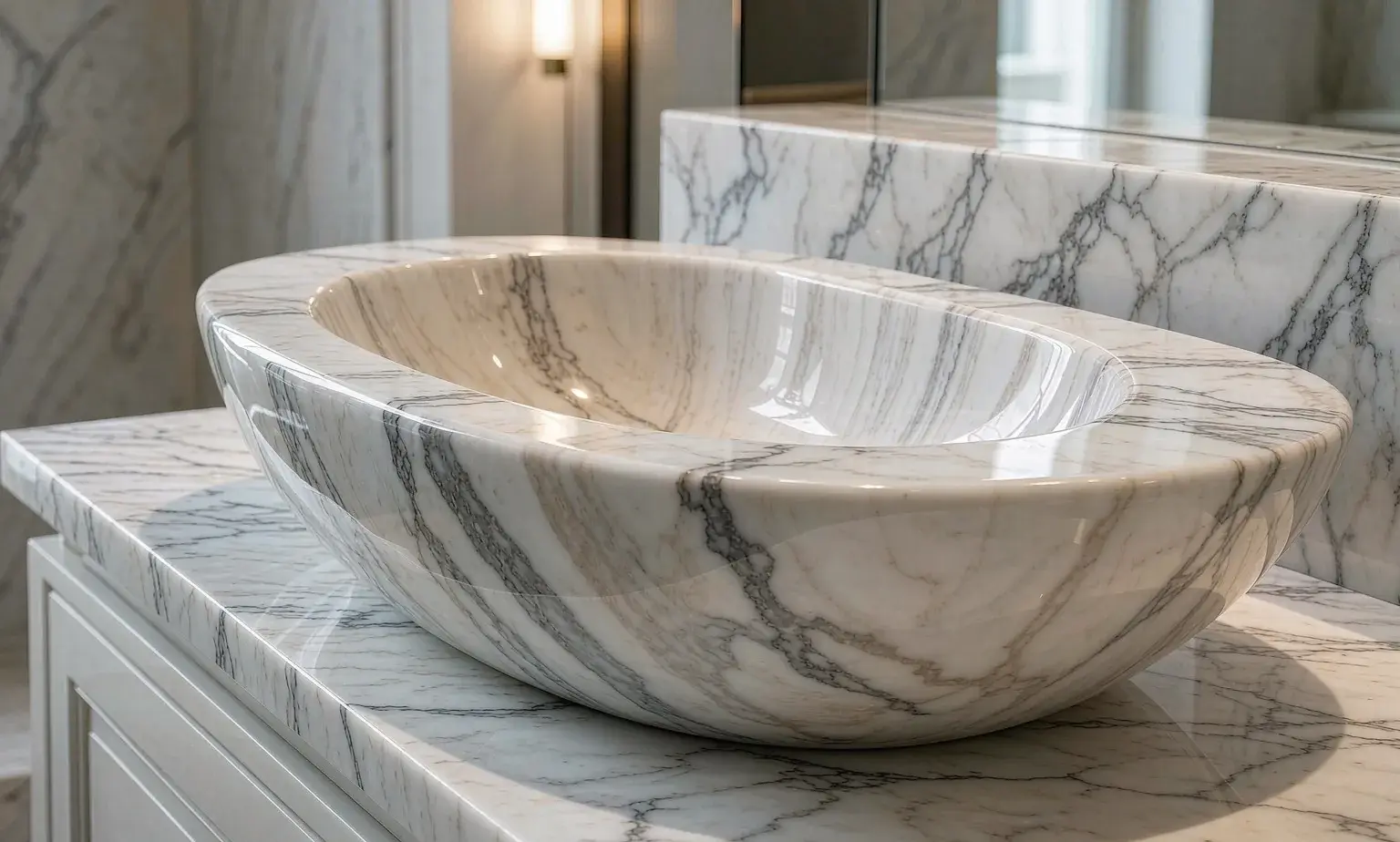
Water and stain resistance: quartz clearly safer
Quartz is non-porous, so water and cosmetics cannot penetrate and no sealing is required. Marble has capillaries, so constant moisture and cosmetics left standing cause staining and marks; it must be sealed and resealed. In a permanently damp bathroom, quartz's advantage is clearest.
Appearance: marble veining is irreplaceable
The natural veining and warm touch of a marble top are hard for quartz to replicate fully, and both marble and acrylic solid surface can be carved into integrated basins. Quartz stone-look decors have improved greatly and look close to natural stone from a distance.
Integrated basins
Acrylic solid surface can be thermoformed into a genuinely seamless integrated basin. Marble can be carved or assembled into a one-piece basin but shows joints. Quartz joints can be polished to a hairline. For true seamlessness, acrylic solid surface is the only answer.
Practical recommendation
Choose quartz for waterproofing and zero maintenance; marble for veining if you will maintain it; acrylic solid surface for a genuinely seamless integrated basin. You can also mix them, with a quartz top and marble walls and floors, balancing looks and practicality.