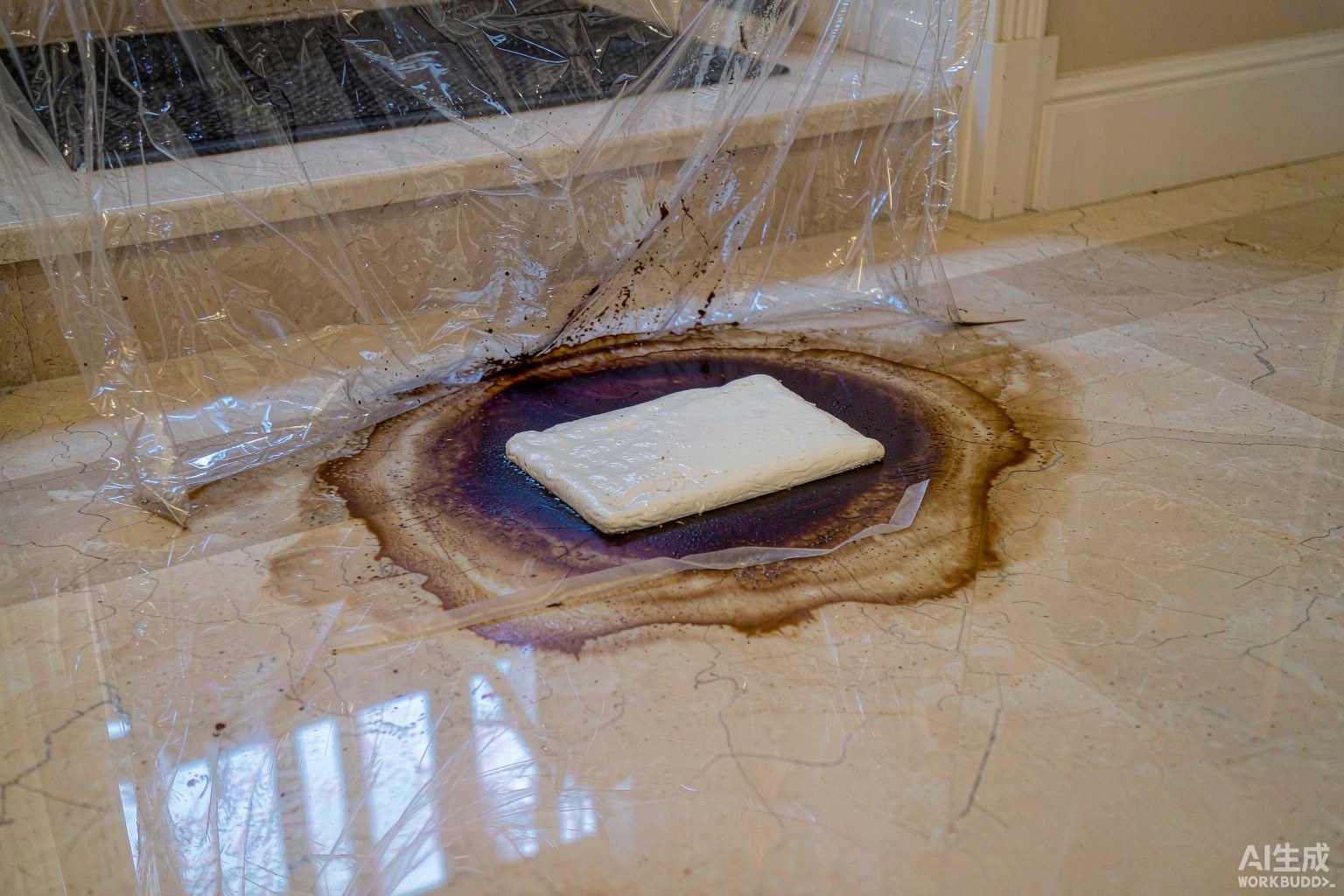
A splash of coffee, red wine, tea or cooking oil on a marble countertop, floor or wall can seep in and leave a darkening mark that seems to grow. Many owners panic, but marble is a natural stone with microscopic pores, and liquids are absorbed slowly — this is called staining. This guide shows how to treat stains by type, how to lift them with a hydrogen peroxide poultice, and when you should hand the job to a professional.
A stain is not permanent damage. Water-based stains (coffee, tea, wine) usually sit near the surface and can often be lifted if treated promptly; oil-based stains (cooking oil, soy sauce) drill deeper and must be drawn out with a poultice. Never use bleach or scrub with a wire pad — that only makes things worse.
How staining works: marble's micro-pores
Marble is mainly calcium carbonate, formed with countless microscopic pores and crystal-boundary gaps invisible to the eye. Even when polished smooth, these pores remain, and liquids wick inward by capillary action. Water-based stains tend to spread outwards and stay pale; oil-based stains drill downward into a dark patch. So step one is always to judge whether the mark is water- or oil-based — get the direction wrong and you waste the effort.
Treatment by stain type
Coffee and tea (water-based)
These usually stay shallow and hit unsealed marble worst. Blot the surface residue, then apply a diluted neutral stone cleaner (pH neutral — never acidic), leave a few minutes and gently blot. If a mark remains, make a paste of baking soda and a little water, lay it on the stain for about half an hour, then wipe. Dab, don't rub: marble is soft and rubbing leaves scratches.
Red wine (coloured, water-based)
Wine carries pigment and tannins, so it is stubborner than coffee. Absorb it at once (don't spread it), then lay a tissue soaked in 3% hydrogen peroxide over the spot for about 15 minutes, repeating several times. Dark marble tolerates peroxide fairly well; on light marble watch closely — peroxide mildly bleaches, so stop as soon as the mark fades.
Oil and soy sauce (oil-based)
Oil is the troublemaker because it keeps drilling down. Surface oil can be lifted with diluted dish soap, but a stain already inside must be drawn out with the hydrogen peroxide poultice below. Never think scrubbing with more cleaner solves it — oil and water don't mix, and scrubbing only spreads the mark.
The hydrogen peroxide poultice, step by step
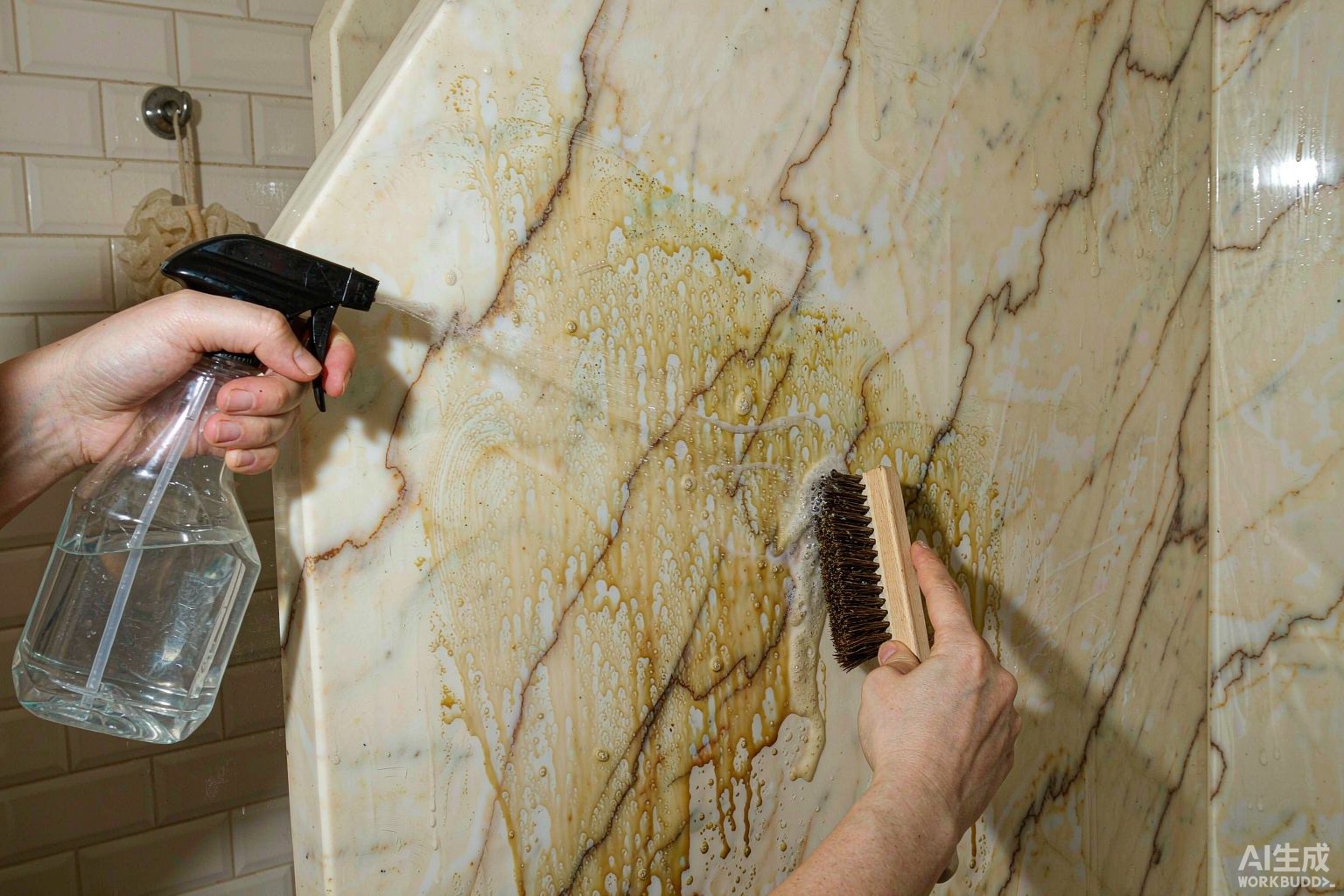
A poultice works by mixing a drying powder (white kaolin clay, corn starch or a dedicated poultice powder) with hydrogen peroxide into a paste laid over the stain and covered. As it dries it pulls the oil up out of the stone. Steps:
| Step | Action | Note |
|---|---|---|
| 1. Clean | Wipe surface dirt with neutral cleaner | No acidic cleaner |
| 2. Mix | Poultice powder + 6–12% peroxide to peanut-butter paste | Mix just before use |
| 3. Apply | Thick layer over stain, cling film, prick holes | Film slows drying |
| 4. Wait | Rest 24–48 hours until fully dry | Shorter on light stone |
| 5. Remove | Scrape off, rinse, dry, check result | Repeat 2–3 times if needed |
Two to three applications usually show clear fading. If there is no progress after several tries, or the stain is deeper than half the slab, stop and let a professional do a deep restoration.

What never to do
First, no bleach. Bleach reacts with marble's calcium carbonate, yellowing, powdering and destroying the surface. Second, no wire brush or scouring pad — marble's Mohs hardness is only about 3, so it scratches irreversibly. Third, no "natural" lemon or vinegar cleaning; the acid etches marble and kills the shine on contact. Fourth, don't blast it with a hot dryer to speed things up — the heat can crack the stone.
When to call a professional
Call a team like Hengsheng when: the stain is months or years old and oil has reached the stone's core; the marble is both etched (a matte white patch) and stained and needs grinding plus re-crystallisation; the area is larger than half a countertop or a whole wall; or you have tried the poultice two or three times with no result. Pros use machine grinding, re-crystallisation and even local colour repair to bring the stone close to new. Prices indicative; final quote depends on spec and market.
Prevention beats cure: how to use a sealer
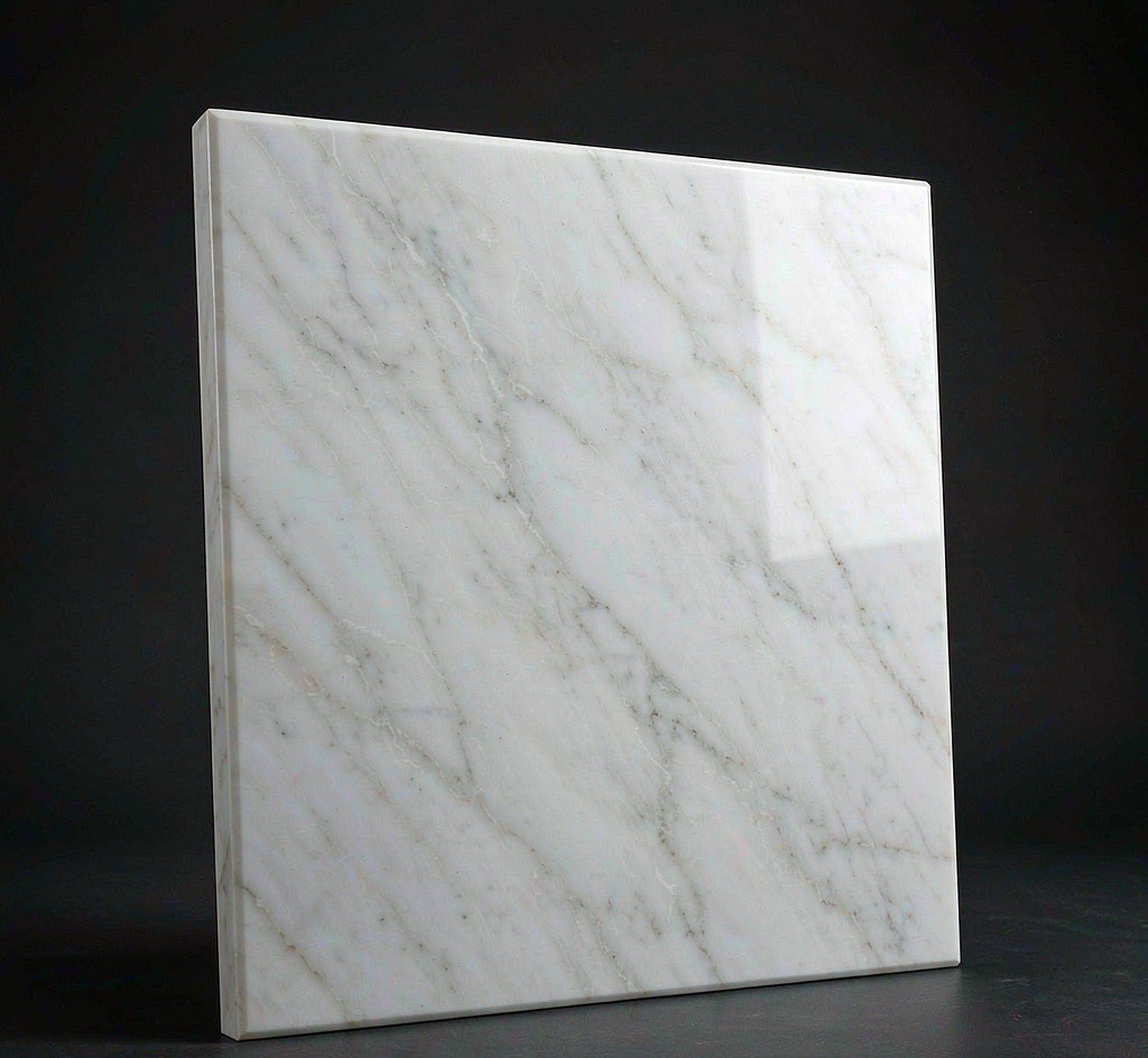
The easiest path is to seal new marble with a penetrating impregnator right after installation. The sealer fills the pores so liquids can't easily enter, and everyday droplets bead on the surface for you to wipe. Home surfaces generally need re-sealing every 1–2 years; high-use kitchen counters benefit from yearly sealing. Hengsheng's projects include sealing and crystallisation so the stone leaves protected. Remember sealing isn't magic — still wipe spills fast, it just buys you time.
Different marble varieties stain differently
Although all called "marble", stones from different origins and base colours vary in density and absorption. Typical marble density is about 2.6–2.7 g/cm³ with absorption around 0.1%–0.3%, but light marbles with looser, more porous veining (some white marbles) run higher and stain more easily, while dense grey marbles resist better. This explains why the same coffee splash looks so different on two marbles. So when choosing stone, beyond the look, ask about absorption rate and whether it is sealed. Prices indicative; final quote depends on spec and market.
Daily care tips
For daily marble care, a slightly damp cloth with a neutral cleaner is enough; follow with a water rinse and blot dry. Use coasters and trivets, and don't place coloured drinks or oil bottles directly on the surface. Occasionally apply a thin layer of stone conditioner to keep the shine and add a layer of protection. With good habits, marble stays beautiful for over a decade.